

The Connection Code
What happens when people feel genuinely connected to their work, their leaders, and each other.
Something fundamental has shifted. Most organisations are still catching up.
Today’s world is a paradox. We have never had more abundance, yet so many basic human needs feel out of reach. We are hyper-connected through technology, yet more isolated emotionally. We have flexible “work from anywhere” policies, but our downtime has been compromised.
The result is a workforce more disconnected than ever – and for companies, that is a productivity and talent crisis. What if the fix isn’t something brand-new, but something already hard-wired into each of us?
The Connection Code sets out the twelve forces that pulled us apart, why previous inclusion efforts fell short, and the four-pillar framework we use to rebuild connection at work.
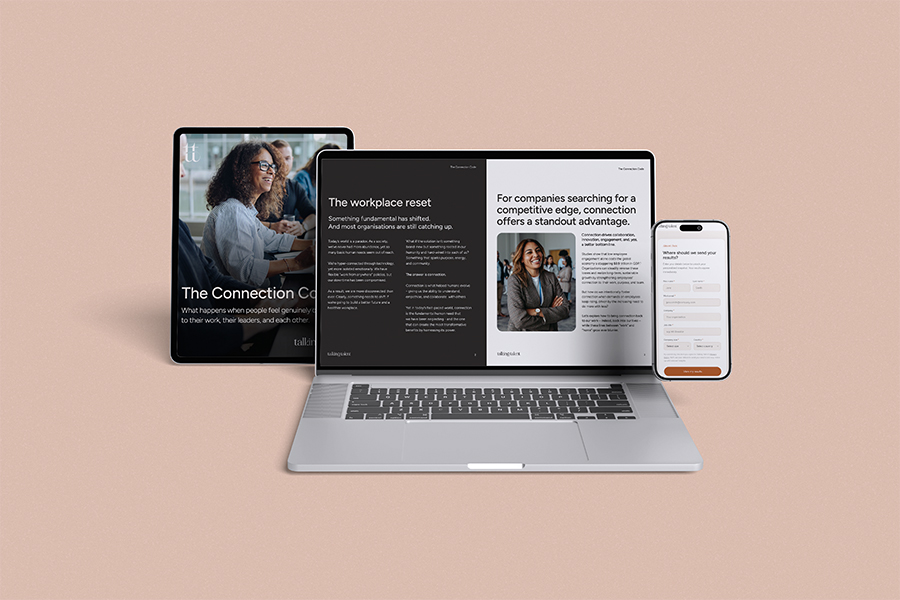
The Connection Code
Eighteen pages on why connection is the human need the workplace has been neglecting – and what to do about it.
Access the Guide
"*" indicates required fields
Trusted by global industry-leading brands















$ 8.9 trn
Lost to disengagement10 %
Engaged at work6 x
More innovative
Why connection works
Connection is hard-wired into humans.
Neuroscientist Dr Matthew Lieberman argues that our need for social connection is as fundamental as food and shelter. Throughout history, survival depended on group cohesion – isolation simply wasn’t an option.
Yet as organisations have grown, so have the barriers that divide us: silos, competition, disengagement. The strongest companies don’t just recognise the need for connection; they build environments where people align around a shared purpose while treating differences as a strength.
This isn’t about homogenising everyone. Group belief is not group think. When people unite around a mission, they are more willing to combine strengths, experiment and adapt – which is precisely where breakthroughs come from.
Companies with inclusive cultures are 36% more likely to achieve above-average profitability. Inclusive teams are 87% more likely to make better decisions.
The Connected Journey
You can’t just tell employees to “connect”. You have to create the conditions where new habits form and stick. Behaviour change science gives us a framework to do it – built on four core pillars.
Who this paper is for
It’s for leaders who are asking:
- Why does engagement keep sliding despite everything we’ve invested?
- Why did our inclusion programmes stall after the training ended?
- Why do we keep losing the talent we worked hardest to find?
- What actually changes behaviour, rather than just awareness?
It may be less relevant if:
- You’re looking for a compliance checklist or a policy template.
- You want a one-off workshop rather than sustained change.
- You need tactical HR process design rather than a cultural diagnosis.

What next
Talent doesn’t leave organisations. It leaves environments that hold it back.
We should talk about that. Twenty years of coaching has taught us that when talented people struggle, it’s rarely about them – it’s about the structural, behavioural and cultural patterns quietly holding them back.
What does The Connection Code cover?
It examines why workplace connection has eroded – twelve mega-trends from the digital revolution to declining religious affiliation – and sets out the Connected Journey: a four-pillar framework covering culture, leaders, talent and life.
Why have previous inclusion efforts fallen short?
Three reasons recur. Interventions focused on changing individuals rather than the broader behavioural and cultural patterns. Training was treated as a one-time fix rather than sustained practice. And senior leaders treated inclusion as an HR initiative rather than a core business priority.
Is this just another DE&I paper?
No. The argument is that the most effective approach has always been building genuine connection to purpose, work and one another – focusing on our shared need for belonging rather than emphasising differences between groups in a way that creates otherness.
What role does coaching play?
Behaviour change requires consistent practice and reinforcement over time. Coaching is what turns good intentions into everyday habits – for leaders, for under-represented talent, and for people navigating the transitions where work and life collide.
How do we know where our own gaps are?
Start with data. Our free Connection Audit is a three-minute diagnostic that scores your organisation across the same four pillars and returns a visual snapshot.