

From Outsiders to Insiders: Solving the 33% Belonging Gap in Financial Services


Despite years of effort to modernize, diversify, and digitize, the financial services industry is still grappling with a stubborn and costly issue: disconnection.
While 4 out of 5 financial services professionals say they want to belong, a third say they feel like outsiders. That’s not a minor morale problem—it’s a massive connection gap.
Belonging is the foundation for engagement, retention, and resilience. And the price of ignoring it? Turnover, burnout, stalled innovation, and a workforce that’s present but disengaged.
Here’s the opportunity: this gap is solvable—and the upside is big. Organizations that close this gap don’t just feel better, they perform better. Employees who feel a strong sense of belonging at work are significantly less likely to quit. In some studies, workers with high belonging are up to seven times more likely to stay than those who feel excluded.
Research consistently underscores the benefit of workplace connections. For example, employees who have a friend at work are up to seven times more engaged. Those with strong social support are significantly less likely to experience burnout. And workplaces with a strong culture of connection generally see higher retention, better learning and knowledge sharing, greater innovation, and improved worker wellbeing.
Connection doesn’t just support the work—it powers it.
Financial services runs on precision and performance. But behind the quarterly reports and digital dashboards, there’s a more human equation in play. And right now, that equation is breaking down.
For example, Mercer’s 2023–2024 “Inside Employees’ Minds” study found that while employee engagement rose in many sectors, it declined in financial services, where workers were less likely to feel a sense of belonging to their team.
That same year, Deloitte found almost half (45%) of women in senior leadership roles at large U.S. financial firms said they were likely to leave their employer within a year (41% for next generation women).
Employees across the industry are increasingly isolated. They feel unseen by leaders, unsupported, and unsure of their future within the organization. This growing sense of disconnection shows up in:
When people feel disconnected, they don’t take risks, they don’t speak up, and they don’t stay. That’s not just a culture problem—it’s a competitive one.
Workplace connection isn’t a luxury; it’s leverage. Employees who feel like they belong are:
And the inverse is also true. Teams where people feel like outsiders often see a domino effect of miscommunication, lowered trust, and dwindling productivity.
So what’s getting in the way of connection?
The way we work has changed faster than the way we lead. Distributed teams, evolving job functions, and mounting performance pressures have all made it harder for people to build and maintain meaningful workplace relationships.
Get this: According to research published in Harvard Business Review, the top use for GenAI in 2025 is for therapy and companionship. Just last year, the leading use case was idea generation. That shift says a lot about what’s missing in the workplace.
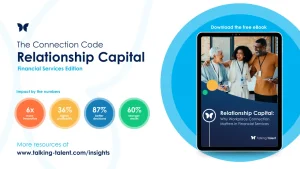
Belonging doesn’t happen by chance. It requires intention, structure, and consistent reinforcement. That’s where the Connection Code comes in—a four-part approach to embedding connection at every level of the organization.
Strategies that work:
Strategies that work:
Supporting employees as whole people isn’t just a retention strategy; it’s a performance imperative.
Strategies that work:
Strategies that work:
The future of financial services will be defined by more than just tech transformation or regulatory shifts. It will be shaped by how deeply organizations understand and invest in what makes people stay, grow, and thrive.
That starts with connection.
The belonging gap isn’t just a people problem. It’s a business performance problem. And it’s one we can solve by treating connection not as an afterthought, but as an operating principle.
At Talking Talent, we’ve spent the past two decades helping organizations build cultures of real connection—where people don’t just work together, but thrive together.
Our coaching, facilitated discussions, and inclusion programs are designed to close the belonging gap by supporting leaders, empowering talent, and reinforcing systems that drive sustainable performance.
We’ve spent years helping global financial firms turn connection into capability—building cultures where people don’t just stay, but lead.
If you’re ready to close the belonging gap, we’re ready to help.